A complete guide to GICs

5 minute read

Person sitting on a sofa in a bright, modern living room, gently petting a large white dog, with a dining area and large windows visible in the background.

Whether you're looking to start investing, diversify your portfolio, save for a down payment or just earn more interest than a savings account alone, GICs can help you achieve your financial goals. They are guaranteed secure investments with very little risk. You set the amount, your financial institution sets the interest rate and you both decide when you get to cash out with your return. The great thing about GICs is that you can use them for both long-term and short-term needs.

This article is designed to give you an overview of GICs and some ideas of how you might incorporate them into your financial plan. Let's explore:

  1. What are GICs?
  2. How do GICs work?
  3. Are GICs safe?
  4. Are GICs worth it?
  5. What are the pros and cons of GICs?
  6. How can I use GICs strategically?
  7. What are other types of GICs?

What are GICs?

A GIC (Guaranteed Investment Certificate) is a cash investment with a guaranteed return and generally offered at a fixed interest rate over a set period (the term). You’ll also encounter the term term deposits, which are basically the same thing as GICs.

Depending on the type of GIC you purchase, interest can be paid to you annually, at the end of the term or sometimes even monthly.

How do GICs work?

Understanding whether your GIC is redeemable, non-redeemable or fully cashable is essential based on your goals. If you’re parking your rainy-day fund in term deposits, you'll want them to be liquid (readily available), so you can access your money in case of an emergency.

If you're using them to save for a purchase you know is five years away, you can keep your money working for you by locking it into a longer-term deposit with a higher rate. Often, this long-term strategy can be used to “purchase an income” in retirement for yourself or a family member.

In buying a GIC, you also get the option to have the interest compound, or to pay out monthly, quarterly, semi-annually, or annually. This can be a great way to help boost your income, especially if it’s limited already.

Redeemable GICs

A redeemable deposit means you don’t have to wait until the end of the term to take out your money. Make sure you pay attention to the conditions surrounding redeemable GICs. For instance:

  • It might take 30 days or more before you have access to your funds
  • You might only be able to redeem them on the anniversary date (e.g. after the first year of a three-year term)
  • You might not get the full rate if you redeem early, but instead an early redemption rate

There are other possible conditions, so if you anticipate that you might need to access your money, ask your financial advisor before you purchase a redeemable GIC.

Some GICs are completely cashable, meaning that at any point during the term you can redeem them with no fees or penalties, along with whatever interest you've earned. Because of their flexibility, redeemable GICs will tend to have lower interest rates than non-redeemable GICs.

Non‑redeemable GICs

On the other hand, a non‑redeemable deposit means your money is locked in for a fixed period. This is a better option for your longer‑term goals where you want to store money away and not touch it for the entirety of the term.


Are GICs safe?

Except for prime‑linked and market‑linked GICs, GICs aren't negatively affected by the market. Even with those types of terms, your potential maximum return may be impacted, but your initial investment is protected.

Even if the interest rate on the GIC you deposited changes prior to maturity, you will earn the original rate you got on the day you made your deposit. That’s why GICs are considered secure, conservative investments and a great way to diversify your portfolio.

Are GICs worth it?

GICs will generally give you a better rate of return than a savings account and a much better rate than a chequing account.

With most GICs, your rate is locked, and your returns are guaranteed.

What are the pros and cons of GICs?

When you compare a GIC to a High Interest Savings Account, a GIC tends to have higher rates, but the savings account gives easier access to funds.

Related reading: Complete guide to TFSAs

How can I use GICs strategically?

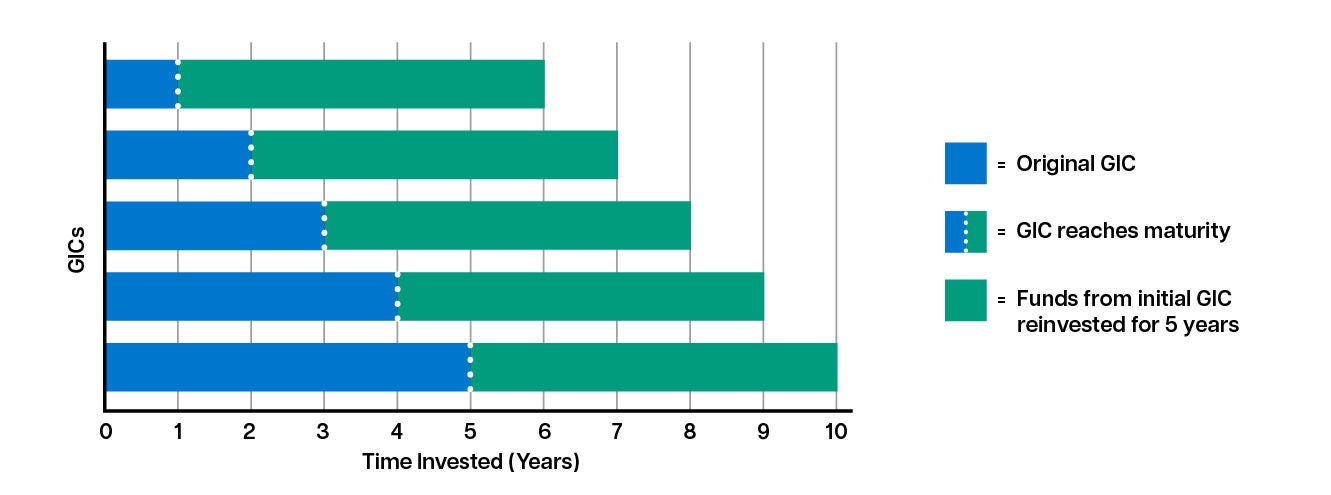
Experienced investors overcome liquidity challenges by laddering their GICs.

How to ladder your investments

graph showing how you can ladder 5 different GICs

Laddering strategies improve liquidity by dividing your investment across multiple GICs with staggered maturity dates.

What are other types of GICs?

Prime‑linked GICs

A prime‑linked GIC changes along with the prime rate. Learn more at the Bank of Canada.

Responsible Investing and GICs

Responsible investing incorporates ESG factors into your GIC strategy.

Learn more about responsible investing and market‑linked GICs.

Mutual funds and other securities are offered through Aviso Wealth, a division of Aviso Financial Inc.

Explore financial planning & advice with your local brand